
17 Wedding Cocktail Hour Games That Run Themselves (While You Take Photos)
You spent 14 months planning this wedding. For 90 minutes of it, you will be standing in a field while a photographer asks you to look naturally at each other for the forty-seventh time. Meanwhile, 80 people you love are at the venue trying to find something to talk about with your spouse's college roommates.
The cocktail hour problem isn't "my guests will be bored." It's more specific than that: your guests will be bored while you are not there to fix it. Most articles about wedding cocktail hour games skip this entirely. They recommend photo booths and lawn games without ever asking who sets them up, who explains the rules, and who keeps things moving when the energy dips. That's usually you. And you won't be there.
This article uses a different framework. Every suggestion below is labeled by one thing: does it need a human to run it, or does it run itself?
TL;DR
- The only question that matters for cocktail hour games: does this need a host present, or does it work without one?
- Tier 1 (Zero-Host) games run on their own: lawn games, phone trivia, printed table cards, guestbook stations.
- Tier 2 (DJ-Anchored) games need an emcee actively working the room. Skip these if you will be away.
- Mixed-age crowds do best with physical games plus one phone option plus a printed backup.
- Set up everything before the ceremony. Test tech the day before. Put a one-line instruction on every table card.
What Makes a Cocktail Hour Game Actually Good
Before the list, the three criteria every item below is judged against.
1. Self-serve or host-required? This is the only thing that matters while you're away. If a game needs someone to explain the rules, call out questions, or manage a scoreboard in real time, it will die in the first ten minutes without that person.
2. Does it work for mixed ages? Your crowd probably spans 70-year-old grandparents and 24-year-old groomsmen. An activity that lands for one group and alienates the other cuts your engaged audience in half. Look for games where participation is optional and low-pressure.
3. Can it be set up in under 10 minutes? Cocktail hour is not the time for elaborate logistics. Anything that requires a coordinator to explain, staff to manage, or tech to troubleshoot on the day belongs in a different tier.
Tier 1: Zero-Host Games
These are the activities worth building your cocktail hour around. Guests can join, play, and finish entirely on their own. No emcee, no explanation, no one standing by to answer questions.
1. Live Browser-Based Trivia (Phone-Based)
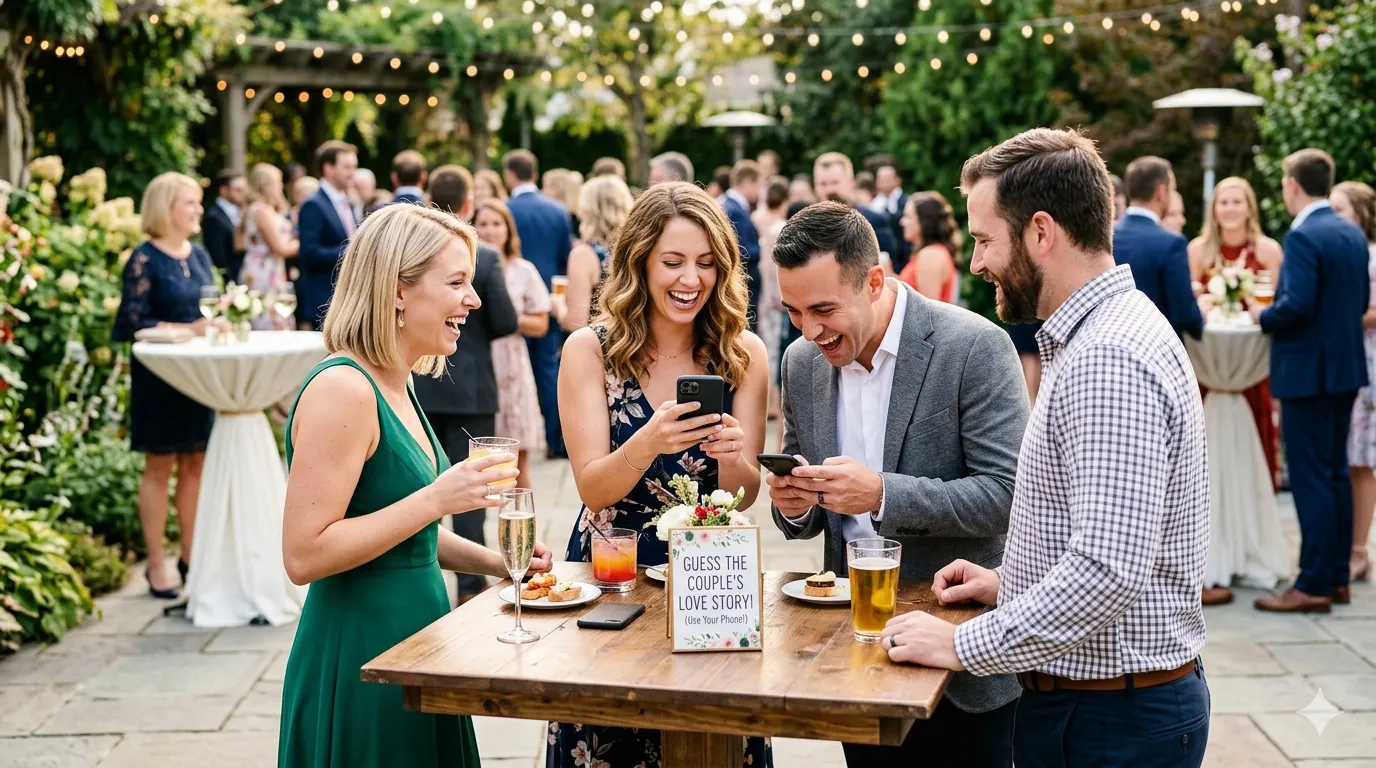
If your guests are comfortable with their phones, live browser-based trivia like ourreception.com is the closest thing to a cocktail hour game that fully runs itself. Guests scan a QR code on the table card, join a live leaderboard, and play until you walk in. No emcee, no explanation needed.
Works for older guests? As long as they can use a phone browser, yes. Put "scan the QR code on your table card to play" in plain text below the code and most guests will figure it out.
Setup time: About 5 minutes the day before. The QR code prints onto your table card. Done.
2. Cornhole
The most socially reliable lawn game ever invented. People already know how to play, it creates natural side-by-side conversation, and it scales from two players to eight with no rule changes. Older guests play it just as happily as younger ones.
Buy a set, put it near the cocktail space, and it runs for the full 90 minutes without anyone touching it. Tradeoff: you need outdoor or patio space, and it gets loud. If your venue is a quiet indoor ballroom, skip to the next option.
3. Giant Jenga with a Question Block
Standard giant Jenga runs itself. Writing a question or dare on each block adds an interactive layer without adding complexity. Questions like "Tell us how you met the couple" or "Share your best marriage advice" keep things wedding-relevant.
Older guests? Yes. The conversation prompts are the real activity. People gather to watch even when they're not pulling blocks.
Use a Sharpie, not a paint pen, on Jenga blocks. Paint pens smear when handled. A thick Sharpie dries fast, stays readable, and survives being dropped on a lawn.
4. Table Trivia Cards (Printed)
One printed card per table, eight to ten questions about the couple, a pencil, and a note that the couple will reveal answers during dinner. No phone required, no electricity, no tech risk. This is your best option for any guests who won't use a phone.
The tradeoff is you get no live competition or leaderboard, so the energy it creates is quieter. Pair it with a phone-based game for the guests who want more.
5. Wedding Bingo
Pre-made bingo cards with wedding moments as the squares: the flower girl trips on her dress, someone cries during the vows, the DJ plays a song from the '80s. Guests carry their cards into the ceremony, fill them out, and compare notes during cocktail hour. No host required at any point.
Works for all ages. The only logistics are printing the cards and having a small prize for the winner. Cost is basically zero if you print at home.
6. Yard Dice (Farkle or Yahtzee)
A set of oversized dice and a laminated score sheet. Guests who want something competitive can run their own game. Guests who don't can watch. No one needs to be "in charge."
Older guests? Great fit. Yahtzee is familiar. The oversized format makes it easy to see and handle.
7. Lawn Bowls or Bocce Ball
Lower-intensity than cornhole but equally self-running. Bocce works especially well for mixed ages because the pace is slow and the rules fit on one index card. Set it up, leave a laminated rules card near the set, and walk away.
8. A Polaroid or Instant Camera Station
Set out one or two instant cameras, a short printed instruction (press the button, wait for the photo, sign the back and drop it in the basket), and a basket for guests to leave their photos in. Those photos become your guestbook, and guests love seeing the physical print come out.
Tradeoff: Film runs roughly €1 to €2 per photo. Budget accordingly and set a gentle one-or-two-photos-per-guest note on the card.
9. Conversation Starter Cards at the Bar
Not a game exactly, but the most underrated cocktail hour activity. Small printed cards at the bar with a few prompts: "How do you know the couple? What's your best piece of marriage advice? What's your prediction for their first argument?" People pick one up while waiting for a drink and suddenly have something to say to the stranger next to them. Free to make, five minutes to set up, zero maintenance.
10. A Couple's Timeline Guessing Game
A large printed or framed poster with eight to ten milestones from the couple's relationship (first date, first trip together, engagement) but with the dates removed. Guests write their guesses on sticky notes. The couple reveals the answers at dinner.
Older guests? Extremely accessible. No tech, no rules, just curiosity. This one tends to draw clusters of guests who end up sharing their own stories, which is the real win.
Tier 2: DJ-Anchored Games
These only work if your DJ or emcee is actively running them. If you're away taking photos and your DJ is playing background music, these activities die quickly. Use them only if your emcee has specifically agreed to run them.
11. Music Bingo (DJ-Led)
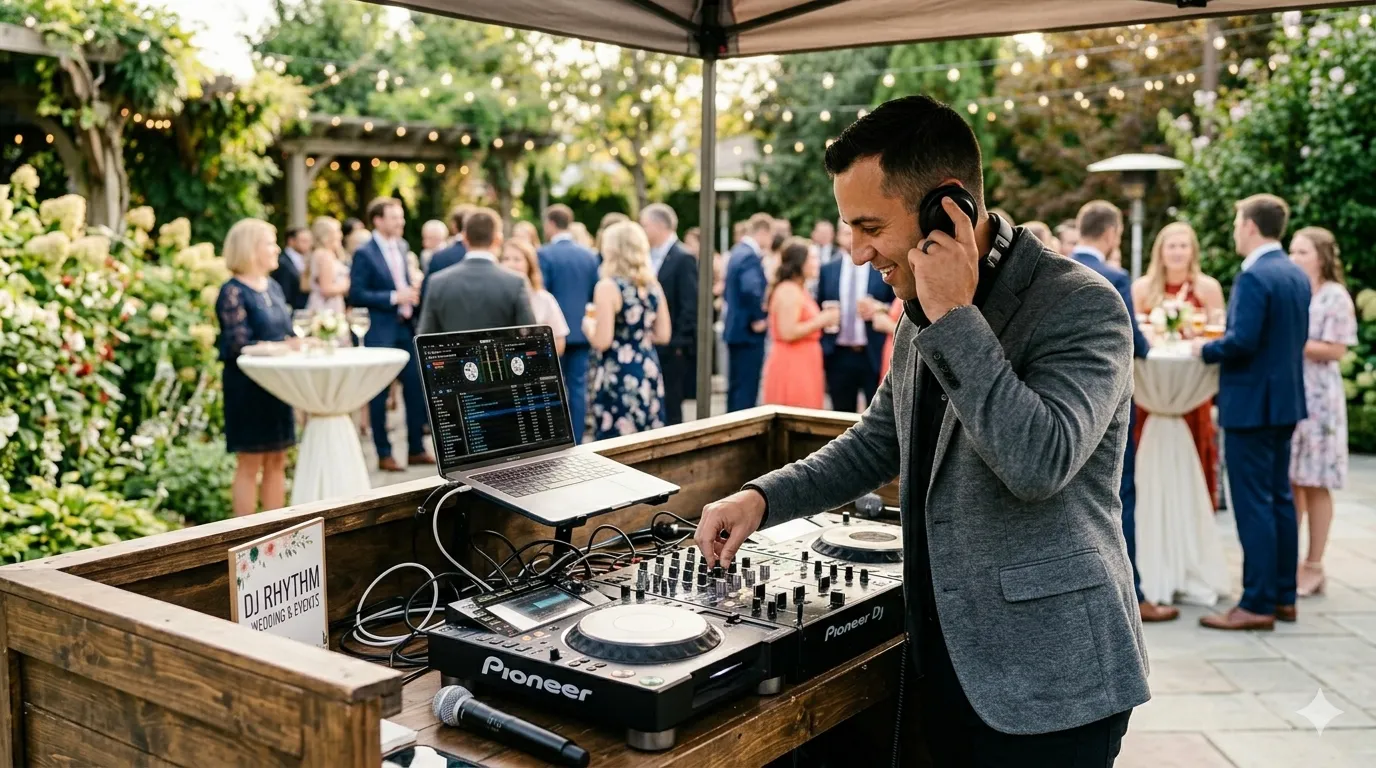
The DJ calls out artist names or song titles and guests mark them on bingo cards. Works brilliantly with the right DJ who commits to running it actively. Without real-time calling, it's just a piece of paper.
Who this is for: Couples whose DJ has specifically done this before and is enthusiastic about it.
12. Crowd Trivia via Microphone
Some DJs will run a short trivia session over the mic: "First person to the DJ booth with the correct answer wins a drink ticket." Fast, social, requires zero guest setup. The tradeoff is complete dependency on the DJ's energy and timing. Ask before you book whether they've done this.
13. Newlywed Predictions Wall
A chalkboard or whiteboard where guests answer prompts about the couple ("Who will do the dishes first year?", "First argument will be about:"). Works as a self-serve tier 1 activity, but lands much better when an emcee reads the best answers aloud to the room at dinner.
14. Guest Shout-Out Segment
The DJ opens the mic for 60 seconds of short toasts or well-wishes from any guest who wants to say something. Chaotic in the best way. Requires someone managing the mic, the timing, and the occasional guest who thinks 60 seconds means 8 minutes.
15. Team Dance-Off (Pre-Dinner)
Organized by the DJ into spontaneous dance-offs by table. Absolutely depends on a high-energy DJ with a willing crowd. Spectacular when it works. Know your crowd before putting this in the plan.
16. "Two Truths and a Lie" Table Tournament
The DJ announces a table-by-table round of two truths and a lie. Requires active facilitation. Without it, some tables play enthusiastically and others ignore it entirely.
17. Photo Challenge Announcement (DJ-Led)
The DJ announces a specific photo challenge ("Everyone take a photo with someone from a different table and show it to your neighbors"). Creates movement and cross-group mingling. Needs the DJ to announce, remind, and reward.
Talk to your DJ before the wedding day, not the morning of. Send a list of which Tier 2 games you want and confirm they have done them before. "Are you comfortable running crowd trivia?" gets a real answer. "Can you do games?" does not.
The Mixed Crowd Problem
Ninety guests at a wedding typically means three or four completely different social groups who would not naturally talk to each other. Your spouse's family. Your college friends. Work colleagues. People who drove four hours and don't know a single other guest.
The activity that bridges this gap is the one where participation is optional and watching is still interesting. Cornhole does this. Giant Jenga does this. Table trivia does it in a quieter way. (If those groups also speak different languages, see bilingual wedding entertainment for games that work in any language.)
A few things that actually help:
Assign a "table captain." One guest per table who knows the couple well and has been quietly asked to keep the energy going. This isn't a formal role, just a text message beforehand: "Hey, would you mind making sure people at table four are having fun during cocktail hour?" Most people are happy to help.
Put QR codes on the menu card, not a separate piece of paper. Separate cards get stacked, buried, or thrown away. A QR code printed directly on the menu card is already in every guest's hand. One-line instruction: "Scan to play live trivia with everyone here."
Don't over-program. Two or three activities running at once is plenty. Guests who want to socialize without playing anything should feel zero pressure to join in.
What to Skip
A few things that get recommended constantly and reliably underperform during cocktail hour.
Photo booths. The setup is expensive, the line creates a crowd that blocks the bar, and the props end up on the floor by hour two. You get thirty very similar photos of guests making the same face. If your budget has room for a photo booth, that money does more work as extra bar service or better table games.
Karaoke. Requires a brave first volunteer, active DJ facilitation, and a crowd that's had more to drink than cocktail hour allows. Save it for the after-party.
Forced team formation. Any game that starts with "split into two teams" requires someone to do the splitting, someone to manage disputes, and about eight minutes of awkward shuffling before anything begins. Guests who don't know anyone feel singled out. Skip it.
Trivia that requires collecting paper scoring sheets. The game lives and dies on paper logistics. Someone always loses the sheet. Someone always cheats. Use a phone-based version where scoring is automatic. For a bank of crowd-pleasing prompts, see funny wedding trivia questions. And if you're planning games for the events before the reception, bridal shower trivia and rehearsal dinner and hen party trivia have dedicated question sets.
Checklist: Setting Up a Self-Running Cocktail Hour
Use this the week before the wedding. To see where cocktail hour sits in the rest of your night, the free reception timeline builder lays out the whole reception around your drinks length.
- Confirm your zero-host games are set up before the ceremony. Lawn games assembled, table cards printed, guestbook station ready. Nothing should require setup during cocktail hour itself.
- Put a one-line instruction on every table card. "Pull a block and answer the question" or "Scan to join live trivia" is enough. Don't over-explain.
- Test your tech the day before. If you're using a phone-based trivia game, scan the QR code on two different phones (one iPhone, one Android if possible) and confirm it loads. Venue Wi-Fi can be unreliable. Check that it works on mobile data too.
- Have printed cards as a backup. Even if you're running phone-based trivia, two table trivia cards per table costs almost nothing and saves you if tech fails.
- Brief your venue coordinator. They should know where games are set up and be able to answer "what's this for?" from confused guests. One email the week before is enough.
- Tell your DJ what's already running. If you have Tier 1 games going, your DJ doesn't need to fill dead air with announcements. If you want Tier 2 games, confirm the plan explicitly and in writing.